Shelf Life: Keeping CBD Calm, Labelled and Out of Harm's Way in a Shared Home
Every shared house has one drawer that makes no sense. Mine, for two years, held a single fork, a roll of duct tape and a bottle of CBD oil with no label and a sticky ring around the cap. Nobody knew whose it was. Nobody wanted to ask. It sat there like a small unspoken thing until the day a friend's toddler came round and started opening every drawer in the kitchen.
That's really what this piece is about. Not the oil itself, but the quiet habits around it — the small decisions that stop a wellness product from becoming a household mystery, and stop a household mystery from becoming a household problem.
Start with the boring bit: it's a product, treat it like one
CBD sold in the UK is regulated as a food supplement, not a medicine. It is not licensed to treat anything, and the sensible starting point is the label on the bottle rather than anything you read on a forum. Keep it in the original packaging, keep the batch number legible, and keep the leaflet if there is one. If you ever need to check something — strength, carrier oil, how to store it — the original bottle is the only reliable source you'll have six months later.
That's it. That's the whole foundation. Everything below is just the practical stuff that grows out of it.
The three rules that prevent ninety per cent of the awkwardness
Shared houses don't need a constitution. They need about three lines that everybody can remember after a pint.
- One person, one bottle, one shelf. Your product lives in your space, not in the general-purpose cupboard where anyone might pick it up by accident.
- Nothing unlabelled. If it doesn't say what it is and who it belongs to, it goes in the bin. No detective work required.
- Nobody else doses from your bottle. Not guests, not visiting cousins, not the housemate who's 'just curious'. CBD is for adults who have chosen it, and sharing a flat isn't consent.
Write them on the inside of a cupboard door if you like. Or just say them out loud once, at a normal volume, over a cup of tea. That's usually enough.
Label like you mean it
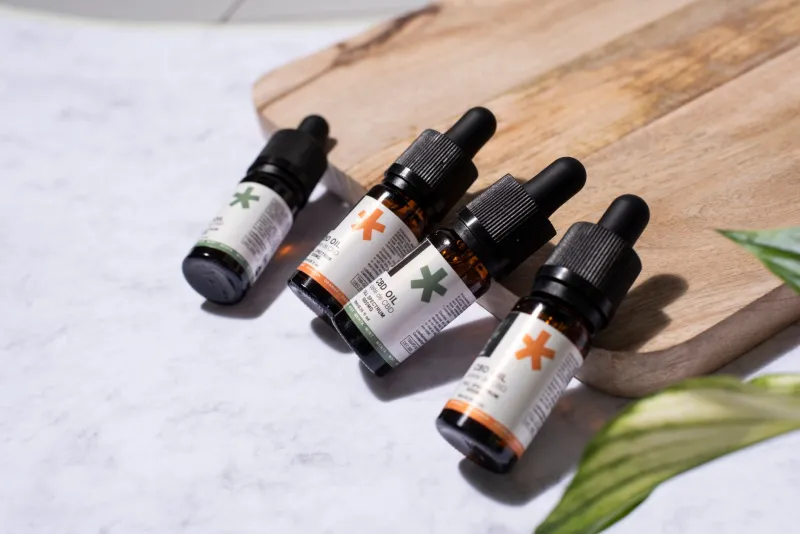
A strip of masking tape and a marker will do. What you want on it is simple: what the product is, whose it is, and the strength. Something like 'Sam's CBD oil, 10%, do not use without asking' is the gold standard. A sticky note that says 'mine' is not.
Where people get caught out is decanting. Buying a big bottle and splitting it into a little amber dropper for the handbag is understandable, but it strips away the batch number, the ingredients and the safety wording in one go. If you do it, copy the details onto the new container. If you can't be bothered to do that, don't decant.
Children, pets and the visitor problem
This is the part that deserves real attention rather than a shrug.
Children. Keep CBD well out of reach — a high cupboard, ideally one with a catch or a lock, and never a handbag on the floor. If children visit regularly, put the whole lot in a single lidded box that lives above adult eye level. And keep the conversation age-appropriate: small children don't need a lecture, they just need the box to be boring and out of reach.
Pets. Dogs and cats are far more sensitive to cannabinoids than we are, and a dropped capsule or an open bottle on a low table is a genuine risk. If you live with animals, treat your CBD like chocolate: never on the sofa arm, never on the floor, never in a bag they can nose into. If you think a pet has got into it, call your vet straight away rather than watching and waiting.
Visitors. A surprising number of people assume anything on a kitchen counter is communal. Assume the opposite and store accordingly.
Keep the kitchen out of it
The shared kitchen is where these things go wrong, because it's the room with the most traffic and the least privacy. A few small habits help.
Don't leave bottles beside the kettle or the chopping board. Don't keep CBD in the fridge next to the milk, where anyone might grab the wrong bottle in the morning fog. Don't store it in the bathroom — the humidity and temperature swings are unkind to oils. A cool, dark, dry cupboard in your own room is genuinely the best place, and it has the happy side effect of keeping your things yours.
If you vape, note that most shared tenancies and family homes are smoke-free indoors, and that's a reasonable rule to respect anyway. Take it outside, keep it away from doorways and windows, and don't leave kit on the draining board.
Talking about it without a slideshow
You don't owe anyone a presentation, but one calm sentence goes a long way. Something like: 'I use a CBD oil in the evenings, it's in the black tin on my shelf, and I keep it away from the kids and the dog.' That covers the product, the location and the safety concern in one breath, and gives people permission to ask follow-up questions if they want to.
Be equally relaxed about the reverse. If a housemate says they'd rather it wasn't in the kitchen at all, that's a fair request — move it. If a landlord or letting agent fixates on it during an inspection, keep things simple: it's a legally sold food supplement, stored in your room, in its original packaging, and it isn't being consumed on the premises in any shared space. Check your tenancy if you want certainty; most standard UK agreements don't mention it at all.
The one rule about old bottles
CBD oils have a shelf life, usually printed as a best-before date, and once opened they don't improve with age. Half-finished bottles from two summers ago aren't a collection, they're clutter with a safety risk attached. If it's past its date, smells off, or you genuinely can't remember buying it, let it go. Some UK councils take small quantities of leftover supplements in the general waste rather than the recycling; check your local guidance rather than guessing.
The short version
Keep it in its original bottle. Write your name on it. Put it somewhere high, dark and dry. Tell the people you live with, once, in plain language. And never leave it where a child or a dog could reach it.
Shared homes run on small courtesies, and this is just one more of them. Handle it calmly and it stops being a thing anyone needs to talk about.